THE HISTORY
OF
GALWAY.
PART III.
THE ECCLESIASTICAL HISTORY OF THE TOWN TO THE PRESENT TIME.
Collegiate Church of St. Nicholas. 2
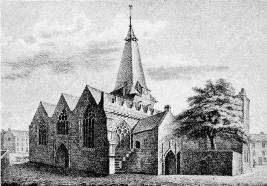
THIS ancient and venerable edifice, which, for extent and architectural beauty, is inferior to very few ecclesiastical foundations in the kingdom, stands a lasting testimonial of the piety, wealth and public spirit of its founders, the former
inhabitants of Galway. It is situate on a gentle eminence, nearly on the northwest extremity of the town, and contiguous to the river, on the site of a small chapel, which was the original and only place of worship belonging to the settlers, until, their wealth and affluence having increased with their industry and trade, they resolved to adorn the town by erecting a more superb structure for the service of the Deity. The present church was accordingly founded in 1320, and, on its completion, was solemnly dedicated to St. Nicholas of Myra, the tutelar saint of mariners, who was chosen as the patron of the town in consequence of its early and extensive commerce. The original foundation was gradually enlarged by the piety of individual benefactors, until, in course of time, it became one of the finest ecclesiastical structures in Ireland.
The town of Galway originally belonged to the diocess of Enachdune, an ancient bishoprick, united in 1324 to the archiepiscopal see of Tuam. Since this union the church of St. Nicholas was governed by vicars, instituted by that see, who were commonly of Irish extraction, and, of course, entirely different from their English parishioners, as well in their principles as in their manners and common habits of life. In this state, discontents and jealousies between the clergy and their flock were inevitable. The latter constantly complained that their Irish pastors were generally prejudiced against them, as being of English origin, and that they invariably countenanced and abetted their own friends and kindred of the Irish race, by whom the town was on all sides surrounded, and with whom the town's-people were in a state of continual hostility. The affairs of religion being thus circumstanced within the town, Donatus O'Murray, who was elected archbishop of Tuam in 1458, at length interfered, and, in consideration, as is said, of an ample equivalent bestowed by the inhabitants, and annexed to the see, he of his own authority erected the church of St: Nicholas into a collegiate of exempt jurisdiction, by letters under his seal, dated the 28th September, 1484, and to it united the parish church of St. James of Balenclaer, (now Clare Galway.) This act having obtained the sanction of pope Innocent VIII. by bull, dated the sixth of the Ides of February following, (as particularly detailed in a former part
of this volume,) the inhabitants, or rather the mayor and equals, (pares) of the town immediately proceeded to the election of a warden and vicars, according to the powers with which they were so amply invested by these ecclesiastical dispensations.
The inhabitants of Galway, having thus succeeded, to the fullest extent of their wishes, in getting rid of an exterior, and establishing a domestic, nomination of the clergy, now began to direct their thoughts towards the endowment of the college and the improvement of the church. Dominick Lynch Fitz-John, one of the most opulent merchants of the town, who was mayor in 1486, and chiefly instrumental in promoting the original institution, was one of its principal benefactors. He made several additions to the church, and built a part of the college-house, or residence for the wardens and vicars, to whom in his will he also bequeathed several legacies. The union of exterior additional parishes, to extend the jurisdiction and increase the revenues of the college, was next attended to. On the 7th of August, 1486, William Joyes, archbishop of Tuam, and a native of the town, confirmed by his deed all the former grants and privileges of the collegiate church, warden and vicars; and he soon after united
to the church the parishes of Furanmore, Moygcullyne and Skryne. Notwithstanding these unions, the wardens and vicars were soon after obliged to petition the pope, complaining that certain persons had questioned the union of Skryne and Moygcullyne, although they had obtained possession of the vicarages, the yearly fruits, rents and profits whereof did not annually exceed fourteen marks, and they humbly prayed that his holiness would be, therefore, pleased to confirm the union; which, by bull, dated the 4th of the Nones of June, 1492, the pope accordingly approved of and confirmed. About the same time, Richard de Burgo, clerk of the diocess of Annaghdown, having obtained letters from the holy see respecting the rectory and vicarage of Furanmore and the vicarage of Meary, for the creation of a new canonry, and the erection of one of them into a prebend, the archbishop, by his letters, dated from Galway, 12th of November, 1492, expressly prohibited the judges, named in such apostolical letters, from proceeding in any manner in such erection. By these and similar means the possessions of the collegiate church were gradually extended and protected, until the wardens, at length, found themselves at the head of an extent of territory and population not inferior to some dioceses in the kingdom.
While the possessions of the college were thus rapidly increasing, the inhabitants of the town were not inattentive to their favorite building, the church. James Lynch Fitz-Stephen (who was mayor in 1493, and who had condemned and executed his only son for a rash and cruel murder, see p.70,) made many valuable additions to the church, and, in particular, presented the beautifully stained glass with which the eastern windows were adorned. John Lynch Fitz-Edmund, who was mayor the year following, contributed a large sum towards finishing the college-house. Peter Lynch, burgess, erected in the church the chapel and altar of St. Katherine the Virgin; and by his will, dated
9th February, 1494, devised "his principal stone tenement in Galway, and ten acres of arable land in Athenry for ever, for the perpetual sustenance of one good and proper priest, who should daily celebrate mass therein for the souls of himself, Ellen Blake, his wife, their ancestors, friends, and all the faithful departed." Several similar instances of individual benevolence and devotion occur about this period, by which the possessions of the church were considerably augmented. h
The warden and vicars were not, however, permitted to enjoy their newly acquired possessions in peace, but were continually harassed by the surrounding diocesan clergy, who invariably contested the right of union of the several parishes, and gave the new incumbents every possible opposition. At length, in 1496, they were obliged to petition pope Alexander VI. stating, that, although the several parishes were canonically united to the church of St. Nicholas, yet that Maurice O'Flaherty, clerke, laid claim to the vicarage of the parish church of Moycullen; that Roderick O'Kennewayn and Owen O'Flaherty claimed the vicarages of Kylcommyn and Kilrowan; and that Richard de Burgo and others claimed the rectories and vicarages of Furanmore and Meary; and they humbly prayed relief from his holiness. A bull accordingly issued to the bishop of Clonfert and David de Burgo, canon of the cathedral church of Clonfert, giving them full power to hear and determine between the parties. These commissioners met on the 17th of December, 1497, in the parish church of Ballynpatrick, in the diocess of Clonfert, and, after a solemn investigation, pronounced judgment of intrusion against the persons complained of, and others. These decisions, however decisive as they were in favor of the warden and vicars, did not entirely suppress their opponents, and they were again obliged to have recourse to the holy see. Another bull accordingly issued, dated the 7th of the Ides of January, 1501, directed to the archbishop of Tuam and others, empowering them to admonish "all those sons of iniquity" who had in any manner invaded the rights of the collegiate church, or usurped any of its
possessions; and if they should not restore what they had taken, and desist for the future, then to pronounce against them the sentence of excommunication. This strong remedy seems to have had the desired effect, for it does not appear that any opposition was given to the college for several years after, with the single exception of its determined opponent, Richard de Burgo, the canon of Annaghdown, who, in 1502, petitioned the pope, claiming the right to the rectory of Ballinclaer, though it had been united to the collegiate church at the time of its original institution. A commission accordingly issued, directed to Florence O'Cannovan, to inquire concerning this alleged claim, who, after investigating the matter, decided against it. For some years after this decision the college enjoyed a respite from external opposition, which John Bermingham, warden in 1514, and Henry Brangan, warden in 1557, were successful in preventing, until the archbishop of Tuam united the vicarages of the parish churches of Kinlaghan and Srower to the wardenship, when two of the diocesan clergy, Meiler and Thomas Mac Shonyn, having laid claim to those livings, obtained letters from Rome allowing their claim, under which they received all the fruits, rents and profits of the vicarages. The warden and vicars, on their part, charged them with having obtained these letters surreptitiously, without stating the union which had been made; and having brought the question before the archbishop, he made his decree on 9th January, 1526, annulling the adverse claim, and confirming the previous union. This dispute was succeeded by another concerning the rectory and vicarage of Roscam, which had been shortly before united by the archbishop, but was claimed by Edmund de Burgo, archdeacon of Enachdune. On the petition of John O'Dermode, then warden, to cardinal Wolsey, a commission issued to the dean of Kilfenora to investigate this claim and determine between the parties, who, by his decree, dated the 5th of August, 1529, confirmed the title of the college; and thus terminated all further litigation concerning its exterior possessions.
During the continuance of these disputes, the improvement of the church was carried on without intermission. John French, who was mayor in 1538, made some very considerable additions to it, and, amongst others, erected the spacious wing extending from the north pinnacle to the Chapel of the Blessed Sacrament. Soon after this the first symptom of reformation appeared in the town. Lord deputy Grey having arrived, he seized and confiscated the ornaments of the church; and Sir William Brabazon, vice-treasurer of Ireland, in his "Account of Jewels, Ornaments, Crosses and Images confiscated," returns "forty-five shillings, being the price of such articles seized at Galway, received from Leonard, late deputy of the king." This inadequate return would induce a supposition either that the confiscation in Galway was trifling, or that the embezzlement, with which the ill-fated deputy was afterwards charged, was considerable. However that may be, no farther inconvenience was sustained by the town on account of religion during the remainder of the reign of Henry VIII. In 1542, Christopher Bodkin, archbishop of Tuam, at the request of the mayor and burgesses, in a provincial synod then held in the town, confirmed to the college all the benefices which it had justly and quietly possessed, and all other benefices which it therefore held, and which were afterwards occupied by any others, with all their rights and appurtenances: and here the force of native partiality in this archbishop, and his predecessor, William Joyes, (who were both natives of the town,) is remarkable, they being the only prelates who had confirmed the privileges of the collegiate church from the time of its original institution.
The alarming changes daily making in the affairs of religion, and the indiscriminate seizure of all ecclesiastical property during the latter years of Henry VIII. had, for some time, rendered the clergy and people of Galway apprehensive for the safety of their collegiate church and property, and more particularly when they saw the three monastic foundations of the town dissolved, and their possessions seized into the king's hands. After long deliber-
ation, therefore, they determined to yield to the pressure of the timea, and secure the safety of their religious establishment, by withdrawing their spiritual allegiance from the pope, and transferring it to the king. A petition to his majesty, expressive of this determination, was consequently prepared, but his death intervened before it could be presented. The appearance of affairs on the accession of Edward VI. not having lessened their apprehensions, they persevered in their former resolution, and accordingly a memorial to the same effect (and particularly calculated to succeed in its object, by flattering the king's supremacy, and representing the livings as poor and deserted,) from the mayor, bailiffs, co-burgesses and commonalty, was presented to the lord deputy St. Leger by Richard Blake Fitz-John, the agent employed on the occasion. The matter was referred by the deputy to the king and council; and, after two years delay, the royal grant was obtained under the privy seal, and by authority of parliament, dated at Westminster the 29th April, 1551, whereby the king, as supreme head in all affairs of religion, changed the church of St. Nicholas into a collegiate, to be for ever after called "The Royal College of Galway;" and ordained Patrick Blake, merchant, one of the priests there, warden, and Patrick Kerewan, Thomas Frenche, Darby O'Hoysshyne, John Talman, Derby O'Rowane, John Dermoyte, John O'Brangan and Edward O'Flartie, vicars choral: the college to consist of a warden and eight vicars, who were to be a body corporate, and have perpetual succession, possess a common seal, and enact by-laws for its good government. The mayor, bailiffs, burgesses and commonalty, and their successors for ever, were empowered to elect a warden yearly, and to remove, deprive and depose him and the vicars, and others in
their places to constitute; and to chastise, correct and punish them, as occasion should require. The rectories, vicarages, &c. mentioned in the memorial were for ever united to the college; and the cemeteries of the three dissolved monasteries were also granted for the purposes mentioned in the memorial. P Such were the principal alterations made in the constitution of the collegiate church by EdwardVI.; and under his charter, with some short interruptions, it has been governed to the present day.
An era having been thus formed in the church government of Galway, henceforth it will be necessary to consider the affairs of religion in a two-fold point of view, first as they relate to the Protestant, and next to the Catholic interest within the town. Although, by the grant just recited, the church of Saint Nicholas was changed into a Protestant institution, yet the warden and vicars, for many years after, continued of the old religion, owing to the immediately succeeding Catholic reign of queen Mary, and the unsettled state of ecclesiastical affairs in Ireland during the first years of her successor. Soon after the accession of the former princess, the attention of her Irish rulers was directed towards the state of religion in Galway. Sir Patrick Blake, the warden nominated in the charter of Edward, was summoned to meet the queen's commissioners; but having neglected to attend, a peremptory order was issued to the mayor to apprehend and send him in safe custody within twenty days, with a denunciation of severe punishment in case of neglect. This measure had the desired effect: the warden attended; but, having satisfied the commissioners, he was dismissed by them, without suffering any further inconvenience.
About this time many considerable additions were made to the church by Nicholas Lynch Fitz-Stephen, grandson of Dominick Lynch, whose munificence has been already recorded. Nicholas was mayor in 1554; and, having repaired the works formerly erected by his grandfather, he afterwards built the adjoining tower and the south aisle, then called "Our Ladie's Chapel," but
9now better known by the name of Lynch's Aisle.—These were the last improvements, of any consequence, made by the Catholics in the church during the remainder of this century.
Upon the accession of queen Elizabeth, and the consequent alteration in religion, the Catholic clergy of the town foresaw that a change was not far distant, and they accordingly alienated and granted, in perpetuity, to their friends and kindred, the greatest part of the possessions of the college,' insomuch that, when it was afterwards seized into the queen's hands, and transferred to the reformed clergy, they were found considerably reduced. The same apprehensions of change also prevented the wardens and vicars from paying the necessary attention to the exterior parishes, in consequence of which they were gradually usurped by the diocesan rectors. The church being at length surrendered to the established clergy, whatever remained unalienated of its former possessions were also delivered up; but, being found totally inadequate to their support, it became necessary for government to interfere, and uphold this infant foundation of the newly established faith by augmenting its means: accordingly, by letters patent, dated 20th September, 1578, the queen, in consideration that "the warden and vicars, and their successors, should continue together, and entertain a godly and learned preacher amongst them, from time to time, at their own charges," granted unto them the late dissolved monastery or priory of Annaghdown," in the county of Galway, with all its temporal and
spiritual possessions. They soon after obtained a similar grant of the monastery of Ballintubber, in the county of Mayo. In the same year several useful alterations were made in the church: the western windows were enlarged; and, over one of them, the date still remains engraven in stone. About the same time several other improvements were undertaken." In the mayoralty of James Lynch Fitz-Ambrose, in 1590, a belfry was erected, and a chime of new bells provided, under the superintendence of the mayor, but at the expense of the inhabitants and corporation.
Henceforth, in order to avoid confusion, the affairs of the collegiate church shall be distinctly noticed under two separate heads; first those relating
to the Protestant, and next to the Catholic wardens and vicars of the town, of both of whom an uninterrupted succession has been ever since continued. Those of the established church had, since the Reformation, been elected under the charter of Edward VI.; and nothing remarkable appears to have occurred concerning them until after the troubles of 1641. A survey of the possessions of the college (of which an abstract is subjoined) was shortly before that disastrous period taken by lord Strafford; and, in 1639, his lordship recommended John Hardinge, vice-provost of Trinity College, Dublin, to the mayor, to be elected warden. Upon this recommendation, the corporation, considering "the dilapidations and ruins of the colledge, and of the means and living thereunto belonging, as allso the merit and integrity of the said John Hardinge, and his willingness to do good in that place, and to restore the colledge to a descent state and order for the service of God, to the credit and ornament of this towne, and to the honour and memorie of the founders and benefactors thereof, for the better inhableing the said John in his so pious intentions, they accordingly agreed, pursuant to the powers contained in the grant of Edward VI. to elect him annually during his life, 'he demeaning himself well,' provided their so doing should not tend to the avoydance of the said grant, or the loss of any privilege contained therein."—Leaving doctor Hardinge, therefore, in possession of the wardenship, the reader will now return back a little, to ascertain the state of the Catholic clergy in the town after the Reformation.
12 13As the reformed warden and vicars were chosen under the grant of Edward VI. so those of the Catholic persuasion were uniformly elected under the bull of pope Innocent VIII. This instrument, it will be recollected, vested the power of election in the mayor and bailiffs, or equals of the town, for ever. On the change of religion, when the corporation became vested in the members of the Protestant faith, the Catholic inhabitants still continued annually to assemble, (but in a private manner, to avoid persecution,) and regularly elected their own mayor, bailiffs, sheriffs, and other corporate officers. These were, however, but merely nominal officers; and they appear to have been continued solely for the purpose of preserving the succession of the Catholic wardens and vicars. This anomalous proceeding was soon questioned by the Catholic archbishops of Tuam, who claimed a controlling power when the corporation was changed, and they denied the competency of the self-formed body, styling itself a Catholic corporation, to act under the pope's authority. The town's-people, however, who, at all times, were particularly jealous of any encroachment on their ecclesiastical rights, invariably resisted the interference of the see of Tuam, which afterwards occasioned several disputes between them, as will appear in the sequel. In the year 1620, James Fallon was elected warden by the Catholic corporation, upon which he wrote to the archbishop, "that, though I am well satisfied of the particular privileges granted to the town, and that the confirmation does belong to the body of the colledge, still, to avoid scruples, I thought it very convenient, in person, to ask confirmation from your grace's vicar, which he would not grant, unless he had a general petition from the town; but this they refused, for fear it would diminish in the least their privileges, and so go to the Protestant archbishop, and be lost." He then added, "The people of this town are so stedfast in the matter, that, for all the clergy in Ireland, they would not lose one atom of their privileges."—The question terminated here for the present; but the warden and town's-people, to prevent similar claims for the future, procured in 1635, a confirmatory grant from the then pope, Urban VIII. This instrument, the then archbishop of Tuam asserted, was obtained surreptitiously, and immediately after, in 1637, he revived the claim, on the ground "that the wardenship was not exempt from the ordinary's visitation, or from paying him a synodicum." The warden, on the contrary, insisted, "that his collegiate church was ecclesia insignis collegiata et exempta ab ordinaria jurisdictione;" but to this the archbishop replied, "that he deceived himself by attributing to his own those privileges which he found to have been granted to collegiate churches, habentis jurisdictionem episcopalem, vel quasi episcopalem, of which his is not, ut patet legenti ejus privilegia, quae sunt restringenda et non amplianda."—These ecclesiastical disputes here ceased for a while, but were renewed, with greater warmth than ever, after the restoration of the Catholic corporation, in 1643.
In 1643 the Catholics possessed themselves of the church, and, on the 18th of June, "mass was solemnly sung therein, and a sermon preached by father John Kegan, of the society of Jesus, after a discontinuance thereof ever since the suppression." About this time a vacancy having occurred in the parish of Clare, the archbishop of Tuam refused to admit a priest presented by Walter Lynch, the warden, except on these conditions; 1st. that the archbishop should approve of him; 2d. that he should be obedient to the provincial and diocesan synods and statutes; 3d. that he should give no contradiction to the archbishop's visitation, correction, procuration, &c.; 4th. that he should give under his hand to be obedient to his lordship's sentence touching the controversy between them. These disagreements occasioned violent personal animosities between the contending ecclesiastics, who proceeded to excommunication on both sides. They at length agreed to submit to the final determination of the bishops of Elphin and Clonfert, the vicar apostolic of Kilmacduagh, Sir Lucas Dillon, knt. one of the supreme council, and Richard Martin, esq. mayor of the town, who finally succeeded in composing their differences." The warden and vicars soon after obtained a grant from the corporation of three parts in eight of the tithes, both great and small, within the town, to "recompense them for the profits of their livings, expended since the troubles in repairing the church and college-house, and paying 40l. yearly to one of their body for preaching every Sunday in the church."—Of their collegiate rights and privileges the clergy and inhabitants were always specially careful, but they were particularly so against any infringement of the see of Tuam. This feeling was forcibly evinced in 1648, when John Burke, the then archbishop, after his dispute with the nuncio, (vide page 125,) caused the church doors to be broke open; he was obliged, on the following day, to sign a declaration, "that, by so doing, he did not intend to interfere with the
liberties of the college."—The important changes, which soon afterwards took place, gave a respite to these clerical contentions; they were, however, resumed, after a lapse of many years, when the Catholic clergy re-appeared in the town, and were not finally concluded until the succeeding century.
During the usurpation of Cromwell, the Catholics were indiscriminately banished, and the rights of the Protestant warden and vicars were totally disregarded. The church was also considerably injured by the soldiery, who converted the chapels and aisles into stables, and destroyed almost the entire of the ancient and venerable monuments, insomuch that at the Restoration it was found entirely in a state of dilapidation, and in total want of repair. Doctor James Vaughan was appointed warden for life by patent, dated 23d March, 1663. During his incumbency, which continued many years, nothing particularly worthy of observation occurred until the year 1682, when the diocesan clergy of Tuam laid claim to the quarta pars, or quarter episcopals, for which they petitioned the lord lieutenant and council. This affair led to another which vitally concerned the rights of the college. John Vesey, the then archbishop, having prevailed on his clergy to drop their petition, undertook to obtain from government a grant in commendam of the wardenship of Galway after the death of warden Vaughan, who was then considerably advanced in years, upon which the quarta pars was to be restored. That event having soon after taken place, king Charles II. accordingly, by letters under the privy signet, dated from Windsor the 30th of August, 1684, reciting that the wardenship was then void, and in his majesty's gift and disposal jure pleno, directed the duke of Ormond to pass letters patent for its perpetual union to the see of Tuam, securing, however, the quarta pars to the vicars of the respective parishes and their successors for ever, they paying to the archbishop a proportionable increase of proxy for such addition. The grant accordingly took place; but the clergy
were disappointed in the expected restitution. The archbishop induced them to enter into a new treaty, and procured their consent that he should enjoy the quarta pars during his incumbency, which continued for thirty-four years after; and, although he was often elected warden of Galway, the union was never esteemed valid, being entirely contrary to the charter so recently before granted to the corporation. d
On the accession of James II. the Catholic clergy again assembled in the town; and, on 29th March, 1688, the then corporation informed archbishop Vesey that his majesty had been pleased to grant them a charter, containing, amongst other privileges, a power to elect a warden and eight vicars, and granting the rights and revenues belonging to the wardenship and college, and others in his grace's possession, which they requested he would forthwith order to be delivered to them, except the church and cemetery, during the pleasure of government. On the 1st of August following, they proceeded, under the charter, to the election of the clergy, when father Henry Browne was chosen warden for that year; and fathers Henry Joice, Michael Lynch, James Fallon, John Bodkin, Jerome Martyn, Nicholas Nolan and Thomas Lynch, were elected vicars. Doctor Vesey having resisted the claims of the corporation, they immediately resolved, that all acts which gave or allowed him any right, title, interest or possession in and to the wardenship, by any way of election, reception,
allowance, or otherwise, should be annulled and vacated. His grace having also retained the church, the newly-elected warden and vicars, in July, 1689, petitioned the king for leave to take possession of it, together with the college-house, stating that the latter "was absolutely in ruin, and that the church was going fast to decay." This petition his majesty referred to the then judges of assize; but they not making any order on the subject, the warden again petitioned the king, stating, "that, by the established law of the land, no Protestant minister or church-man had any right to the church or livings; that he was in the possession of the latter for the last two years; and that no divine service was then administered in the former, either by Protestant or Catholic," and praying "that he might be at liberty to make use of it." Before his majesty's answer could arrive, lord Clanricarde, the governor, anticipating that it would be favorable, delivered the possession of the church to the warden, who immediately took down all the pews, and commenced the necessary repairs. He enjoyed it, however, but for a short time: after the surrender of the town to general Ginckle, in 1691, it was again restored to the established clergy, and in their possession it has ever since remained.
Soon after the restoration of the church, archbishop Vesey petitioned parliament that the archiepiscopal see might be removed from Tuam to Galway; a change which, after some consideration, was accordingly resolved upon by a committee of the entire house, who further recommended that a cathedral and dwelling should be provided for his grace; that 2000l. should be raised to defray the expense, by a tax on the town and liberties, 500l. whereof were to be appropriated for the purpose of repairing, building and beautifying the church. A bill, pursuant to these resolutions, was prepared, which, on 6th September, 1697, was referred to a committee; but, a petition against it having been, in the mean time, presented by the corporation, the bill was consequently rejected. This measure of doctor Vesey would, if successful, have been of considerable benefit both to the town and the see; and, although the advantages which would attend such a change are obvious, yet the subject has never since been revived by any of his successors. What further remains concerning the affairs of the church, since that period, will occupy but very few words. In 1726, an organ was erected, which cost the corporation 180l. In 1734, the reverend Samuel Simcockes was elected warden, in place of Henry Hart, deceased. The income of the wardenship was then estimated at 500l. yearly, but it is now considerably more. The present possessions consist of the vicarage of the town, with the rectories and vicarages of Ballinacourty, Clare-Galway, Kilcommon, Moycullen, Oranmore, Rahoon and Shruel. A church has been lately erected in Kilcommon; but there is neither church, glebe-house nor glebe-land in any of the other out-parishes. The reverend James Daly, the present warden, is resident in the town, and has cure of souls of all these
parishes. The duty is performed by him and two resident vicars. They are elected annually under the charter. The latter receive a stipend of 751. a year each, and are said to rank as king's chaplains. The warden has been always entitled to the tithes and emoluments of the parish of St. Nicholas, and to three-fourths of the tithes of the other parishes. The right of presentation to the remaining fourth belongs to the see of Tuam in free disposal; but the warden and vicars claim an exemption from any other interference or jurisdiction of the archbishop except that of visitation.
This already protracted detail shall now be concluded with a brief description of the venerable building to which it relates, and which, without exaggeration, may be pronounced one of the most perfect and beautiful specimens of the simple Gothic or Norman architecture, (by some called the pointed style,) now remaining in this kingdom. The exterior of this ancient edifice, though evidently the work of different periods, is remarkable for uniformity in the execution, and for order and plan in the general design. Like most ecclesiastical edifices of the same style of architecture, it is built so as to resemble in shape the sacred emblem of our salvation: and within its ample walls, it has been ascertained, that upwards of five thousand persons might be conveniently accommodated at divine service. It extends in length, within, from the east end of the choir, along the nave, to the principal entrance at the west, 152 feet; in breadth, from north to south, including the transept, or cross aisle, 126 feet; and in height, to the vaulted roof, 42 feet 10 inches. The side aisles are separated from the nave by two rows of Gothic pillars, with arches springing from them, which support the roofs. Each of these pillars is 8 feet 10 inches in circumference; 12 feet 10 inches from the base to the top of the architrave; and the chord of each arch measures 14 feet 6 inches. From the intersection of the aisles arises the square tower on which the steeple was erected in 1683, in a style of architecture
no way corresponding with the rest of the building. The entrances and windows, which all display the pointed arch, were richly decorated with sculptured ornaments, containing many allegorical and ecclesiastical subjects, and exhibiting various traces of drapery, intermixed with fruit, trefoils, festoons, &c. in the same appropriate style, ingeniously designed and elegantly executed. Some few of these are still remaining, which escaped the ravages of time and the devastation of the fanatic crew by whom, as already detailed, almost every sacred monument in the church was destroyed; and it is here added, with regret, that what even these despoilers had spared were ultimately doomed to destruction by the ignorant alterations of modern church-wardens, under the specious name of repairs and improvements. Notwithstanding these interpolations, however, the interior of this spacious structure, taken from the western vestibule, and terminated by the lofty window in the choir, (which, with those on the west, had formerly been embellished with beautifully stained glass,) presents, even still, a view altogether worthy of its external appearance, and one capable of inspiring the mind with mingled sensations of awe and veneration. When, with this view, the spectator shall, in his imagination, combine the fourteen ornamented altars and chapels, already enumerated, with which the church had been once so brilliantly adorned, the monuments and numerous statues of saints and other holy men, amongst whom that of the patron, St. Nicholas, was eminently conspicuous, a tolerably adequate idea may then be formed of the ancient splendor and magnificence of this stately edifice.
To proceed, however, to particulars, it will be necessary, in the first place, to notice the north or French's aisle. This compartment corresponds in height with the roof of the nave; but a portion of it and the adjoining transept is occupied by the organ-loft or gallery, erected in the last century, nearly parallel with the pulpit, but, as it must be confessed, with very little display of taste, either in the design, position or execution. Although the traces
of antiquity throughout the church are less numerous than might be expected from the date of the building, there are, notwithstanding, a few handsome monuments, and some inscriptions, which shall be noticed in order. In this aisle, on a black marble grave-stone, the following Irish names are legible:—Wilielmus D'Builn and Margaret H. Niguane; on another, Here lieth the Body of On Wor—ford, Shumaker, and his wife, Juaninia Chlinge—who—1577; and on another, curiously engraved, Dir lieth the Todi of On Woriertha D'Tiernagh, and his wife, Kate Birnanigonohid, and his brother, Teige Dg—An' Dni 1580. Passing from the north to the south transept, Joyce's marble altar, placed in an arched recess, forming a curved square of 9 feet 10 inches, deserves notice. This recess was converted into a commodious pew, some years since, by the O'Hara family, to the memory of some of whom a handsome monument has been here erected.
On entering the south or Lynche's aisle, the polished marble altar and window of exquisite beauty, built by the founder of this extensive wing, and which now form its principal ornaments, will immediately attract attention. On both sides of this curious altar there are raised tombs, highly sculptured, belonging to various branches of this ancient family: one of these is the tomb of Nicholas Lynch Fitz-Stephen, by whom this aisle and the adjoining tower were erected. A small marble tablet, inserted on one side of the altar, contains the following inscription commemorating one of his descendants:
Stirpe clarus, amor militum, terror inimicorum, aetate iubenis, sener virtutibus, mundo non digno eraltatur ad coelum, \circ . Partii. Anno Domini 1644.—Stephanus Lynch.
Many other monuments and sepulchral inscriptions are interspersed throughout this aisle, n but the principal are to be seen in the choir, amongst which those belonging to the Eyre family are the most conspicuous. There are several spacious vaults in various parts of the church; but they are seldom opened, having been almost entirely abandoned, at the time of the Reformation, by the Catholic families, who resorted to the abbey of the Franciscans, where the
ancient monuments are consequently more numerous: and, though the cemetery attached to the church is extensive, it is said that none, even still, are interred in it but members of the established religion.
The ancient college-house, or former residence of the warden and vicars, is a spacious edifice, situate within fifty feet of the western extremity of the church. Some remains of antique sculpture are yet to be seen here, with the entrance of a subterraneous passage (long since closed up) which led to the high-altar in the choir. This house is now divided into several tenements, occupied by various families, who hold under the established warden; and with it this section shall be closed, in order to proceed to the consideration of the other religious establishments in the town.
An elegant marble monument, on the north side of the choir, contains the following inscription:
Near this place are interred the remains of Edward Eyre, Esq. son of Giles Eyre, of Brickworth, near Salisbury, in Wiltshire, Esq. together with his wife, Jane Eyre, a virtuous, charitable, pious, and in all respects an exceeding good woman. Three sons and two daughters their children.
He was a thorough honest Englishman: which plain character bespeaks him eminently possessed of all good and virtuous qualities. He lived greatly beloved by all that knew him, and died, much lamented, on the 14th of April, 1683. In memory of so worthy a Father and Mother their duteous Son, Edward Eyre, of Gallway, Esq. has erected this Monument.
Here also lies Edward Eyre, Esqr. who erected this monument. He died ye. 5 of Nov. 1739, aged 76 yrs. He married Jane, the Daughter of Sir Wm. Maynard, of Walthamstow, in Essex, Bart. by whom he had 4 Sons and 5 Daughters. His Wife and 3 Daughters survived him. He left large Charity to build an Alms House, and to maintain 12 Poor for ever.
On another handsome monument, immediately adjoining the last, the inscription is as follows:
Near this place rests,
in full assurance of a blessed Resurrection,
Jane Eyre,
Daughter of Sir William Maynard, Baronet,
and Relict of Edward Eyre, late of Galway, Esqre.
She was a loving and obedient Wife,
a careful and indulgent Mother,
Affable and courteous to her Acquaintance.
Her piety, prudence and well-disposed bounty to the poor,
giving bread to the hungry, and cloathing the naked,
made her a worthy example to her Sex.
She took leave of this World on the 29 day of Decem, 1760,
in the 88th year of her age, resigned herself cheerfully into the hands of her Redeemer,
with a lively faith, a stedfast hope, and that charity which never fails to obtain an Inheritance among the Saints in light.
Two Daughters, Elizabeth and Margaret, survived her.
The Sum of £300 was given by the Widow, Jane Eyre,
to the Corporation of Galway, for the yearly Sum of
24, to be distributed in Bread to 36 poor Objects, on every Sunday, for ever.
Near these is the following inscription on a black marble monument:
Here is interred the Body of Robert Stannard, Lieutenant in the Honorable Colonel Roger Handasyde's Regiment of Foot. He was third Son of Robert Stannard, of the County of Corke. He was born at Wexford, and dyed here, of a malignant Fever, on the 10th day of March, in the yeare of our Lord 1720, in the 34 yeare of his age. He served his Country in Spain faithfully. He lived soberly, and dyed much lamented.
Near this place lyeth the Body of Mrs. Elizabeth Tenison, Wife of Major William Tenison, who departed this Life June the 23. 1741:
She was a woman of an exceeding good character in all respects of Life, and died much lamented by all her Acquaintance.
Likewise his second Wife, Ann Tenison, who was equal in character, and died, equally lamented, April 1st, 1744.
The inscription on the monument of the O'Hara family:
Beneath lie the Remains of Elizabeth O'Hara, Wife of Geffrie O'Hara, Esqre:
She was an English Woman; honest, sincere, charitable, a loving and obedient Wife, and, in every respect, a good example to her sex: She lived beloved, and died regretted, after a long and painful illness, on the 20th of July, 1790, aged 62.
Here also lieth Geffrie O'Hara, Esqre.
formerly a Captain in the E. India Service, who, after many voyages, settled in Galway, the place of his birth; and died, much lamented, on the 25 April, 1795, aged 77. He was a good Seaman, an upright Magistrate, and an honest Man.
Collegiate Chapel of St. Nicholas.
ON the surrender of the town in 1691, the church was delivered up to the established clergy by John Bodkin Fitz-Andrew, who was then, and for many years after, Catholic warden. The several chapels and altars, shortly before repaired and erected, were immediately broken down, and the interior was again fitted up for the administration of divine service according to the rites of the established religion. By the articles of capitulation it was stipulated, that the Roman Catholic clergy and laity of Galway should be secured in the private exercise of their religion, and that the former should be also protected in their persons and goods. Upon that event, the Catholic corporation secretly assembled, and, with the concurrence of the warden and chapter, divided the town and suburbs into separate districts or distinct parishes, which division has continued with very little alteration to the present day. Warden Bodkin was succeeded by the reverend Edmund Lynch; and the persecutions against the Catholics raging violently during his wardenship, the scattered remnants of the collegiate property were collected and privately transmitted to France. Here they were converted into money, which was placed at interest; and the fund having, in a few years, considerably increased by donations and bequests, was applied to the purchase of an income in Paris, which was annually remitted to Galway, and divided amongst the warden and vicars for their support. The sacred utensils and other church plate, then valued to be worth upwards of 500l. were also conveyed to France, and deposited in the Irish college at Paris, where they remained until the period of the French Revolution, when they were seized and confiscated. During the incumbency of warden Lynch, and also of his successor, Patrick Skerrett Fitz-Michael, the persecutions against the Catholics continued
unabated. The Catholic corporation, or "lay-patrons," however, from time to time assembled, and elected the wardens and vicars; but these persecuted individuals were repeatedly arrested and imprisoned for attempting to perform their clerical duties, insomuch that they were often obliged to officiate in the dead of the night, and not unfrequently to steal, disguised in woman's apparel, to visit the sick and dying. These severities, however, gradually declined; and, about the year 1725, the warden and vicars fitted up a chapel in a warehouse belonging to Anthony Bodkin, merchant, situate in Middle-street, where they, for the first time since the surrender of the town, publicly officiated. In 1731, the severe penal visitation, already described, (p. 174,) took place; and the subjoined extract from the return made by the mayor, on that occasion, will give the reader some idea of the state of the Catholic clergy in the town at that period.
A short time previous to this event, the reverend Patrick Bermingham, of the family of Barbersfort, in the county of Galway, a clergyman of profound learning
and considerable talent, was elected warden, and was the only person not of the Galway names and families, already enumerated, who had been elected to that dignity for the preceding century. He, it is said, was chosen by the "tribes," or ancient families of the town, to pacify the natives, or inhabitants of other names, since called "non-tribes," who about that time began to complain that the former had wrongfully usurped to themselves the right of election and presentation of the clergy. Doctor Bermingham, soon after his election, was arrested by the mayor, and thrown into prison, on a charge of not having conformed to the regulations prescribed by law for popish priests; but, it appearing that he had regularly complied with those rules, he was released by order of government. During his incumbency, the old disputes between the archbishop of Tuam and the collegiate clergy, as to the jurisdiction of the former over the warden and vicars, were again revived, and proceedings were at length instituted in Rome between doctor Bernard O'Gara, the then archbishop, and the clergy and people of the town. On this occasion a commission issued; and Cornelius O'Keefe, titular bishop of Limerick, was delegated to proceed to Galway, and there to examine into the grounds of these differences. A compromise at length took place between both parties, and certain articles were agreed to, by which it was conceded, on the part of the clergy and people of Galway, that the archbishop of Tuam, for the time being, should have a right of triennial visitation in capite et membris; and also that appeals might be made, in secunda instantia, from the sentence of the warden to the archiepiscopal see. On the part of the latter it was granted, that the right of election belonged to the lay-patrons; and, amongst other articles, which are subjoined, it was agreed, that the warden should be thenceforth elected every third year, in consequence of the many inconveniences which
attended their annual election. This agreement was approved of and confirmed by the bull of Clement XII. dated 21st April, 1738, and under it the affairs of religion in the Catholic wardenship of Galway have ever since been regulated.
Warden Bermingham died in 1747, universally regretted. He was succeeded by the reverend Hyacinth Bodkin, a pious and learned divine, who survived but a short time, having died in the year 1749. On his death, the reverend Marcus Kirwan, of Dalgan, was elected; but this gentleman having given some dissatisfaction to the lay-patrons, the reverend Anthony Blake, of Dunmacreena, (who was afterwards titular archbishop of Armagh and Catholic primate of Ireland,) was elected in his place: and this, it is said, was the only instance in which any of the wardens had been dispossessed since the Reformation. Doctor Blake erected the parish chapel in Middle-street about 1752, and was succeeded, in 1755, by Francis Kirwan, who filled the chair, with honor to himself and benefit to the town, until his death, which happened in June, 1770; when the reverend John Joyes, of Oxford, in the county of Mayo, was elected. This gentleman continued warden until February, 1783, when he departed this life, leaving behind him the reputation of a good and pious pastor, always zealous in the cause of religion, and particularly so in the reproval of public vice and immorality. He was succeeded by the reverend Augustine Kirwan, a divine possessed of every virtue which adorns the clerical character, and whose piety, meekness and unceasing benevolence, will be long remembered. Amongst many other praise-worthy acts, he established a subscription fund, and founded a school for the instruction and clothing of indigent boys, in which numerous poor children are still carefully taught the rudiments of education, and the principles of religion and morality. Since the establishment of this valuable institution to the present time, thousands have, by its means, been rescued from the paths of idleness and vice, and become useful members of society. Warden Kirwan also instituted Sunday vespers and evening lecture and prayers in the collegiate chapel; and, after many other laudable regulations, this exemplary man departed this life, amidst the tears of the community, on the 7th of August, 1791.
At this time the situation of the Catholics of Ireland was very different from what it had been at any former period since the reign of James II. The day of
25+
25persecution had now passed away, and this meritorious, though long suffering, body at length found themselves under the protection of the laws, and in the enjoyment of the public and undisturbed exercise of their religion. Immediately on the decease of warden Kirwan, the principal Catholics of Galway, composed entirely of the ancient names and families, assembled for the purpose of new-modelling the ancient Catholic corporation; after which they proceeded to the election of a warden in the room of their late venerable pastor. On this occasion there were two candidates for the wardenship, the reverend Patrick Kirwan and the reverend John Joyes, nephew of the former warden of that name, and, after a severe contest, the latter was chosen by a large majority. During these proceedings, the old disputes between the "tribes" and "non-tribes," which had lain dormant for upwards of half a century, were revived with considerable animosity. The reader has already seen that, by the many revolutionary changes which had
taken place since the Reformation, the Catholic inhabitants of Galway lost all their former municipal privileges, except that of the election of their wardens and vicars, which the descendants of the principal ancient names and families contrived, amidst every vicissitude, to preserve inviolate amongst themselves, to the exclusion of all the other natives of the town, even those of their own persuasion. During the last century, however, many respectable individuals of the latter class having become resident in the town, they, in course of time, became discontented, and at length importunate to be admitted to vote at the elections of those clergy whom they contributed so amply to support. This claim, which was strenuously urged on the decease of warden Kirwan, was as forcibly resisted by the others; but, as a matter of favor, they proposed to concede the privilege to such of the opposite party as they themselves should approve of, and as, under
Form of a Warden's presentation, to which that of a Vicar is nearly similar.
To the reverend the Roman Catholic vicars of the R. C. collegiate church of St. Nicholas, in the town of Galway.
A vacancy having occurred by the death of the late very reverend warden, V. B. for the office of warden to officiate in the collegiate church of St. Nicholas, in Galway, we, the R. C. mayor, bailiffs and peers of the R. C. corporation of lay-patrons of the said R. C. collegiate church of St. Nicholas, in said town of Galway, in pursuance of public notice thereof, being assembled in the parish chapel, have unanimously elected the reverend E. F. to fill the office of warden of the said R. C. collegiate church of St. Nicholas, in the said town of Galway, and all its out-parishes annexed thereto, for the succeeding three years, to be computed from the first day of August; and we do hereby present the said reverend E. F. to your reverences for institution.
[Signed by the mayor, recorder, bailiffs or sheriffs, town-clerk, and some of the most respectable peers, (parcs, or equals, supposed to mean freemen or common council-men,) for the time being, of the Catholic corporation.]
Immediately after the decease of warden Kirwan, in 1791, the non-tribes, pursuant to public advertisement, assembled at the tholsel, and formed a Catholic corporation of their own. Walter Burke was nominated mayor, James Burke recorder, Walter Flaherty and Robert Power sheriffs, and John E. Burke town-clerk. They then gave notice that they would, on 10th September, 1791, in the parish chapel, proceed to the election of a warden in place of the deceased; on which day, being denied admittance there, they proceeded to the Augustinian chapel, and the reverend Denis Mannion, one of the vicars, was elected warden, and the reverend Andrew Kenny, vicar in his place; but these gentlemen, not considering the proceedings valid without the sanction of the holy see, declined the honors thus conferred on them. The non-tribes then cautioned the vicars against instituting the clergy elected by their opponents, concluding with these words:—"We charge your consciences, as we shall yourselves at a superior tribunal, to account for instituting any person not properly qualified or legally chosen."—They then transmitted a petition to
Rome, and on the 25th September following, again assembled in the Augustinian chapel, and resolved, "That the bull of 1484, which was originally intended by Innocent VIII. for the general benefit, peace, harmony and unity, at all times, of the citizens of Galway, was shamefully perverted by the party stiling themselves the 13 tribes, (and the clergy of their appointment,) the remnant of a decayed colony.—That as the parish chapel has been on two different occasions shut against us, both by the clergy and thirteen names, we will in future attend prayers at some other of the Galway chapels.—That the conduct of the clergy of said chapel on this occasion has been insidious, petulant and partial, and that they have not, in any one instance, evinced a desire of causing a reconciliation between the parishioners on just, equal and honorable terms; but, on the contrary, openly countenanced the usurped claim of the thirteen names to the exclusive privilege of election, in violation of the express words, intent and meaning of the bull of 1484, which ought to be the rule of their conduct, without prejudice or partiality to either party.—That as the said thirteen names assume the exclusive privilege of electing the Galway clergy, it is but reasonable also they should take on them the burthen of their support; and on our part, we pledge ourselves to each other most solemnly, that we will not, directly or indirectly, contribute any longer towards the support of the clergy of their appointment, particularly by withholding from them marriage-plate and christening money, remembrances, Christmas and Easter dues, and all other dues whatsoever; and that we will not deal with any parishioner who may act contrary to these resolutions, until our rights relative to the election of the Galway clergy are finally ascertained, and this illiberal cause of contention removed.
Signed, by order of the parishioners,
Printed Resolutions. John Burke Edmond, Sec."
Several other meetings were afterwards held, and the irritable feelings and declarations on both sides were very violent. A deputation of the non-tribes waited on the archbishop of Tuam, doctorEgan, offering to surrender the collegiate rights. This prelate, though he at first declined the proposal, afterwards, it is said, secretly favoured the proceedings, and promoted their cause at Rome with all his influence.
such terms, would accept of it, by admitting them free of the Catholic corporation. A few individuals, who had acceded for the purpose of conciliation, were accordingly admitted; but the proffered boon was indignantly rejected by the remainder, who formed the great majority of the inhabitants of the town. A schism from the newly-elected warden was accordingly the consequence. The disappointed party, acting with more precipitancy than judgment, proceeded to the election of a pastor of their own. They finally appealed to Rome, claiming the privilege as a right, and not seeking it as a favor; and, in the mean time, the town became a scene of spiritual anarchy and confusion. A counter petition was soon after transmitted, and the question was at length heard before the congregation De propaganda fide, who decided (with a reservation, however, of appeal,) in favor of the ancient names and families, or lay-patrons, by a decree, which received the sanction of pope Pius VI. on the 17th June, 1792. Warden
lished on 28th July following by the warden and vicars in the parish chapel, the lay-patrons immediately protested against that part of it which declared that the warden was confirmed during the pleasure of the sacred congregation, (the words "holy see" were omitted,) and on 1st August, re-elected warden Joyes; but the chapter refused to institute him, assigning as their reason, "that the warden having been previously appointed by the holy see at will, they could not institute him, there being no vacancy." Upon this the Catholic corporation again assembled, and "solemuly" protested against this refusal, and the reason given for it, as illegal and unjust to high degree."-Orig.MS.
The question to be decided, was, whether the Catholic corporation composed of the descendants of the fourteen ancient names and families, were exclusively entitled, under the bull of Innocent VIII. to the right of electing and presenting the wardens and vicars, or whether that privilege did not equally belong to all the Catholic citizens or inhabitants of the town, without distinction? The principal arguments adduced in this curious case, by both parties, were briefly as follow:—In support of the exclusive right, it was contended, that the ancestors of the fourteen families, who were emphatically stiled Anglo-Galvienses, or English families of Galway, were the original founders of the town and church; that they had richly endowed the latter, and for valuable consideration, (which it is said now constitutes the greatest part of the revenues of the Protestant archbishop of Tuam,) acquired the domestic nomination of their clergy, which they transmitted to their posterity; every one of whom, it was asserted, had as legal a right to this privilege as any individual to his hereditary estate. That, although the original memorial to Innocent VIII. purported to have been that of all the parishioners, yet the pope, knowing the evils attendant on popular elections, confined the right solely to the mayor, bailiffs and equals, or freemen & council, of the town. That this ancient privilege was preserved and handed down, through various persecutions, pure, inviolate and (until lately) uncontroverted, by means of the Catholic corporation; and that it was absurd and unreasonable in the highest degree that "new men" and modern families, not members of that body, but who had come to reside in the town ages after its formation, should intrude themselves, or claim a participation of those spiritual rights and privileges which
Joyes was soon after re-elected; and although this decision has been ever since acquiesced in, it was at the time asserted, on the part of the appellants, that they would have succeeded, had not the court of Rome, alarmed at the then revolutionary proceedings in France, been inclined to discountenance any measure which had the smallest appearance of popular innovation. The subject has, however, been a source of uneasiness ever since to several conscientious members of the chapter, who, considering the great revolution wrought by time, and the alteration of circumstances since the original institution of the collegiate church, have represented that such a change has been effected in the nature of the patronage of its clergy as to render its canonical validity doubtful; but they, at the same time, admit that, although usage or prescription, since the suppression of the Catholic corporation, forms the only tenable foundation on which the right at present rests, yet any material change in the usual and ordinary manner of exercising it can only be effected by the interposition of the supreme ecclesiastical power and the sanction of the holy see, in order to render it valid and canonical. This opinion, however, which militated so forcibly against the exclusive privileges of the lay-patrons, neither coincided with their wishes nor
met their approbation, although it has been confidently asserted that the vicars, and even the warden of the town, during the contest in 1792, had been unanimously of opinion, that some modification and arrangement in the constitution and exercise of this patronage had become highly necessary for the interest of religion in Galway.
The dissensions already detailed having excited the attention of the then titular archbishop of Tuam, they suggested to that able and vigilant prelate a project never until then thought of, and, consequently, at the time totally unexpected: this was nothing less than the total abolition of the collegiate rights and the annexation of the wardenship to the archiepiscopal see, to accomplish which every exertion was made at Rome; but, through the successful endeavours and advocacy of the reverend Valentine Bodkin, agent of the lay-patrons, and afterwards warden of the town, this bold and unprecedented attempt of the archbishop was frustrated. In the mean time, the amiable and conciliatory demeanor of warden Joyes by degrees reconciled matters within the town; and the angry feelings of jealousy and discontent, which had proceeded to considerable lengths amongst several of the inhabitants, gradually subsided. On the decease of this worthy
The author having thus far faithfully endeavoured to collect the arguments adduced by these contending parties, without being conscious of partiality to either, he shall not here presume to draw any conclusion; that he leaves to others; but cannot, however, conclude without expressing a hope that, should the question be ever again revived, the feelings of party prejudice may never preponderate to the injury of religion.
man, in 1805, the reverend Valentine Bodkin, before alluded to, was elected warden. During his incumbency he promoted the establishment of an orphan asylum, for the maintenance, clothing and education of destitute female children. The lay-patrons having soon after resolved not to elect any of the then vicars (who were mostly of non-tribe families) to succeed him as warden, he, at their desire, procured a dispensation from Rome to render eligible three regulars of the town, viz. the reverend John Fallon and the reverend Charles and Edmund Ffrench, two brothers, all of the Dominican order. The latter gentleman was accordingly chosen vicar, and afterwards, on the death of doctor Bodkin, in 1812, was elected to the dignity of warden, a circumstance which occasioned fresh troubles in the town. The other vicars loudly protested against this election, charging the lay-patrons with partiality and injustice. A disunion was accordingly the consequence; the chapter declared the proceedings invalid, refused to confer institution on the newly-elected warden, and finally appealed to the pope, complaining against the innovation of a regular intruding on a secular chapter. Many of the most respectable inhabitants also murmured at these proceedings, the effects of which are not yet entirely over. The election, however, was afterwards, on 18th June, 1813, confirmed by the pope; and the piety, zeal and exertions of warden Ffrench, since his accession to the wardenship, justly entitle him to the respect and esteem in which he is so generally held. To his anxiety for the promotion of religious education, and the improvement of public morals, the town is principally indebted for the establishment of that valuable institution, the presentation convent; and the superb collegiate chapel, now erecting, which may be said to have been hitherto raised by his single exertions, will long remain a splendid monument of his zeal for the interests of religion.
To conclude—the Catholic warden of Galway (who has been sometimes described by the term quasi episcopus) is a prelate chosen triennially by the lay-patrons of the town, who exercises episcopal jurisdiction over an extensive district and population in the capital of the province, but subject to the triennial visitation of the metropolitan of Tuam, who is generally obliged, however, to conclude the business of visitation within a limited time. His institution by the chapter or vicars confers on him all the necessary faculties in ordinary for this jurisdiction: of course, what the confirmation of the holy see confers on a bishop elect, or nearly so, is conferred on him by such institution. He possesses a visitatorial power over all religious foundations within the limits of the wardenship; has privilege of sending two students to the Royal College of St. Patrick, Maynooth; is intitled to a chair and vote in synod, with mitre, crozier and pontificals, as other prelates: but he cannot administer the sacrament of confirmation, confer orders, or consecrate the sacred unction. A vicar of the collegiate church (who is also elected by the lay-patrons, but for life,) is of different signification from what is commonly understood by that name, the vicarage being, in fact, a canonry or prebend in a collegiate chapter. The reverend gentlemen at present composing this venerable body are inferior to none in the kingdom for piety, learning, and zeal in the arduous discharge of their sacred duties.
Franciscan Friary.
THE power of the De Burgos having been firmly established in Connaught, about the close of the thirteenth century, by the favorable issue of their long and sanguinary contests with the native Irish, Galway became (as there had been before occasion to mention) the chief residence of this powerful family, and, consequently, the principal object of its protection and improvement. In 1296, Sir William de Burgh, surnamed Liagh, or the grey, founded this monastery for Franciscan friars, outside the north gate of the town, as particularly detailed
in the obituary of the friary, and the dedication took place on the 16th of May. The founder died 12th Feb. 1324, and was here interred. Several other particulars, concerning this monastery, for the two centuries succeeding this period, were collected, from various sources, by Allemande, Archdall, and others, which are here subjoined. b In addition to these, the following have been gleaned for this work:
1538, John French, who was mayor this year, erected the great chapel on the south side of the abbey, and also the stone building which stood on arches over the river, to the west of the pinnacle, afterwards called "John French's Chamber."
1570, March 9th, Queen Elizabeth granted part of the possessions of this monastery (then lately dissolved, c ) to the corporation, and their successors, which grant was renewed on 1st September, 1578, for forty years.
1603, February 11th, James I. granted the entire possessions of this house to Sir George Carew, his heirs and assigns for ever.
1611, Valentine Blake Fitz-Walter Fitz-Thomas, who was mayor this year, built the chapel on the south side of the choir, wherein he and his family were interred. This chapel was afterwards converted into a sacristy.
1626, April 16th, died Murrough na more O'Flaherty, of Bunowen castle, and, by his directions in his last will, was interred amongst his ancestors in this abbey.
1642, Richard Martin, of Dungorie, who was this year mayor of the town, bestowed 800l. to build two chapels, one in this abbey, and the other in the church of St. Nicholas.
```markdown
```
1643, June 25th, (Sunday,) mass was solemnly sung in this abbey for the first time since its suppression; after which a sermon was preached by father Valentine Browne, guardian. Several improvements were then made in the abbey, and, amongst others, the tomb of the founder was repaired and beautified.
1652, The friars of this house were banished, d and the monuments and ornamental works of the abbey were defaced by Cromwell's soldiery. The superb marble tomb of Sir Peter Frenc, knt. which was richly gilt and adorned with sculptures, was entirely destroyed; part of the polished marble was converted by governor Stubbers into chimney-pieces, and the remainder sent to England, and disposed of at a considerable price. e
1657, All the buildings of the abbey demolished, except the church, in which the courts of justice were held.
1685, Disputes arose between the warden and vicars of St. Nicholas's church and the friars of this abbey, concerning the right of precedency to attend at funerals, and the emoluments thence arising, which being brought before the congregation of the cardinal's interpreters of the council of Trent, they, on the 15th of Nov. this year, determined that "the right belonged to the parish priest."
1689, The friars took possession of the church, in which they made several repairs and improvements, but were soon after dispossessed.
1698, The several members of this and the other religious orders of the town were banished; but they afterwards gradually ventured to return, and for many
years suffered the most severe persecutions, having been frequently imprisoned, tried, transported, and often in danger of their lives.
1724, The abbey chapel was repaired, and mass publicly celebrated, which gave great offence to the heads of the corporation. The friars, four in number, were arrested by order of the mayor, and tried on capital indictments at the ensuing assizes, but were severally acquitted.
1731, The town-sheriffs searched the friary, and the mayor, in his return to the house of lords, stated, that in it "there is a large chapel, with an altar, laid out and adorned with pictures; in which said reputed friary there are fifteen chambers and nine beds, wherein they (the sheriffs) supposed the friars belonging to the said friary usually lay; but could not find or discover any of them. It is an old friary; but the chapel enlarged and repaired about the year 1723 or 1724."
1779, June, the tomb of the founder, Sir William de Burgh, was discovered, upwards of four feet under ground, with his family arms and a long broad sword elegantly carved thereon. The following inscription appears, in raised letters, round the margin :—" Memoriae G. Jilmo. Dno Bull De Burgo suae nationis Principi et hujus monasterii fundatori qui obitt 1324 Posuit F. U. B. G. 1645."
1781, The chapel was rebuilt, before which it was a small thatched edifice, both narrow and inconvenient. Though at present its external appearance is plain, it presents within a spacious, convenient and handsome place of worship, 120 feet long and 30 feet broad, and is capable of accommodating upwards of two thousand people. The altar-piece represents the Assumption of the Blessed Virgin; on one side of it there are two paintings, one of St. Joseph and the infant Jesus, and the other of St. Bonaventure; on the opposite side a St. Peter de Alcantara and an Ecce Homo. There are two side altars, on which mass is occasionally celebrated: over that on the right, from the lower entrance, the altar-piece is a St. Anthony of Padua, and over that on the left a good painting of St. Francis, the founder of the order. The devotion called the stations of the Holy Cross, which is confined solely to the Franciscans, is observed here. The friars reside in a large commodious house, contiguous to the chapel; they occasionally preach, and daily celebrate the divine mysteries; and the accommodation and convenience of the public are attended to on all occasions.
The cemetery attached to this house is extensive, and contains the burialplaces of some of the most considerable families in the province. The monuments are much more ancient than numerous, and the inscriptions generally
contain little more than the names and obits of the deceased: a few will be found selected underneath, which are interesting only for their antiquity, and the respectable individuals whom they commemorate.
The little that remains to be said of this foundation will equally apply to the other convents, of which the separate accounts which follow have been collected. The Franciscans are governed by a guardian, and the Dominicans and Augustinians by priors, who are all triennially chosen. The dwelling-houses in which they reside are commodious, and conveniently situated near their respective chapels. They are principally supported by the interest arising from charitable donations; and they resort to the neighbouring districts, at certain seasons of the year, whence they return with supplies of sheep, grain, potatoes, and other articles of consumption: they also partake of the several sorts of fish taken in the bay, which the fishermen cheerfully and liberally share with them, (but particularly with the Dominicans, who reside immediately near the sea,) under a firm belief that their prayers render the watery element more abundant. Other minor sources of support are chaplaincies, daily masses, occasional high-masses chaunted for the dead, voluntary offerings, mortuary money, remembrance masses, chapel rent, collected annually, and candle money, half yearly. All which, with other trifling contingencies, enable them to live as becomes their sacred character, and, if a judgment can be formed from external appearances, leave them very little reason to regret the forfeited estates and other extensive privileges of their more opulent predecessors.
All those acquainted with the history of the middle ages, or of the times immediately preceding the sixteenth century, must be aware that the state of
Monuments and Inscriptions.
The tomb of the ancient family of O'Nolan, of Loughboy, is situate in the centre of the church-yard, and bears the following inscription:—"This tomb was first erected in the year of our Lord 1394, by the O'Nolans of Loughboy, and is now re-built and ornamented by Michael O'Nolan, merchant, Galway, one of the representatives of said family."
2.
A very curiously carved stone, which lies near the modern tomb of O'Connor, contains the arms of the corporation of goldsmiths, the several instruments of torture used at the Crucifixion, and an antique ship, with the following words, in raised letters, round the margin:
Drate pro animabus Walter in marcachau et Pargarete ni Dabin Aroris ejus, sc corundem parentum, Dui hunc lapidem geri fecerunt, quorum animabus propicietur Deus. Amen. Anno Dui 1579. Thomas Labin Felorcianiveran.
3.
On a large tomb in the S. W. corner:—Pray for the Soule of Alderman Dominick Browne and his Posterity, who dyed in the year 1596. Here lies the Body of Captain Andrew Browne, of Gloves, Esq. whose family tomb this is, which was erected in the year 1596.
4.
On Darcy's vault, in the same corner:
Epitaphium D. Jacobi Darcy Pajoris, Conaciae praec-
dius, Galviae praectoris, &c. Dul oblit an' Dnf' 1608.
Dic amor Heroum, Decus Turbis, norma Senatus,
Pensa peregrini, pauperis arca jacet.
This tomb was repaired by the descendants of James Darcy in the year of our Lord 1728. Pray for the dead.
5.
The centre of the yard, to which the chancel of the old church extended, is the place of interment of the friars of the order and also of the nuns of St.Clare, of the Franciscan observance. There are several monuments with raised, full-length effigies of some of the friars, dressed in their habits, and of the nuns, in their costume. The former bear a chalice in their hands, their shoes are high-heeled, and they wear the cap of their order; the inscriptions are generally in raised letters, round the margin. On one of these the following is just legible:
D Lord have mercy on the Soule of Father Thomas D'Paeony, who dyed the 28 of September, Anno Domini [ ] 6.
On another:
Drate pro anima Thomae French facerdotis qui obitit
Nicelmo Octavo Octobrit 1629. F. B.
the regular clergy was then very different from what it is at the present day. The change of religion in these countries shook the monastic foundations to their centre; and since that great event they have silently undergone a reformation, which the powers of the Vatican, however otherwise formidable, were never able to accomplish. When deprived of their wealth and influence, and doomed to undergo the severity of persecution, their lives exhibited at once all the virtues of primitive christianity. In Ireland, where a parallel to their sufferings can only be found in the early history of the church, no crime immoral or irreligious could ever be imputed to this extensive body of men; on the contrary, their very persecutors often bore testimony to the innocence and sanctity of their lives. All this can here be asserted with confidence, as Galway had been, until the mitigation of the penal laws took place, one of the principal places which afforded refuge to these proscribed ecclesiastics. When, therefore, the quiet and peaceable demeanor of their lives, the laudable example which their piety and morals continually afford, their constant and regular attendance to the duties of religion, and their unceasing acts of charity and benevolence, shall be considered, even the prejudiced themselves cannot but pronounce them most praise-worthy and deserving members of society:
built by James Lynch, merchant, A. D. 1679.; and repaired, in the year 1764, by Alexander Lynch Fitz-John, one of the descendants of said James, and thus ornamented, in the year 1779, by said Alexander. Requiescant in pace."
7.
On another, on which there is carved a full-length figure of St. Clare:
Here lieth the Body of Taet Bily, Dun of the Order of St. Tlara, who died 22 of February, anno 1638. St. Tlara.
8.
On a similar monument, except that St. Clare appears kneeling in the attitude of prayer, the following inscription is legible:
1672. Here lieth the Body of the R. Mother Patia Gabriel alias [ ] Helen Martin, first Abbes and religious of the poor Clares of Galway, who opened the 14 of Jann. auged 68, in religion 40. Pray for her Soule.
9.
On a flat stone, near the foregoing: Here lieth the Body of Nicholas D'Beirne, and his wife, Margaret Dy Bulinan, whose Souls we commit to God. Amen. 1629.
10.
At a short distance from these lies the monument of the Quin family, and on it inscribed:—"This tomb was first erected in the year 1649, by James Quin, of Galway, merchant, and Eleanor Joyes, his wife. In memory of whom, James Quin, of Galway, aforesaid, merchant, one of the descendants of said James, caused the same to be entirely repaired and ornamented, in the year 1762. Requiescant in pace."
11.
A branch of the family of the Lynches have a large tomb here, with this inscription:—"This tomb was first
12.
On a handsome marble monument, near the lower entrance to the chapel:—"Pray for the Soul of Anabella Martin, who dyed Sept. 28, 1766, and is buried in the family vault, near this place."
There are many other monuments, but the inscriptions are mostly defaced and illegible; there are also a great number of modern grave-stones, but few of the inscriptions worth noticing. The two following are selected as the only specimens of monumental verse in the entire:
13.
Cate Kirwan, daughter to Val. Kirwan and Jeane Martin, dyed a child, 1727. I need no pitty, for no guilt I knew; Pray for my neighbours, and I'll pray for you.
As I was once like thee,
So thou shalt surely be
A skel'ton like me;
Then haste and snatch the present hour,
Implore the mercy seat,
Lest death should rob thee of the power,
And doom thy eternal fate.
God be merciful to the Soul of Charles. Bird, who died
y. 18th Feb. 1781.
Dominican Friary.
THIS friary is situate on an elevated spot, near the sea-shore, in the west suburbs of the town. It stands on the site of the ancient convent of St. Mary of the Hill, a daughter of the Holy Trinity, of the Premonstratenses of Tuam, which was founded by the O'Hallorans, but at what period of time the annals of the town are silent; there is, however, every reason to pronounce it of very great antiquity. On the nuns forsaking it, the secular clergy entered, and kept possession for a considerable time; but, on the petition of the inhabitants of the town to pope Innocent VIII. it was granted, in 1488, to the Dominican friars of Athenry, by a bull, which may be seen at full (p. 323) in De Burgo's history of this celebrated order in Ireland.
The Dominican convent being thus established in Galway, was richly endowed by many individuals of the town, and several considerable additions were made to the monastery and church. James Lynch Fitz-Stephen, who was mayor in 1493, and who has been already celebrated for immolating his only son at the shrine of public justice, erected the choir. Various other improvements were gradually made, until, in course of time, this became one of the most perfect religious foundations in the province.
1570, March 9th, Queen Elizabeth granted to the corporation, and their successors, part of the possessions of this monastery, then lately dissolved.
1642, Lord Forbes landing here, took possession of this house, which he converted into a battery, with intent to reduce the town; but having failed in his design, he defaced the church, and, in his brutal rage, dug up the graves, and burned the coffins and bones of the dead.
1652, The church and monastery were surrendered by the friars to the corporation, and were soon after rased to the ground, to prevent them from being converted by Cromwell's forces into a fortification against the town. It was, however, previously agreed upon by the corporation that, on the return of peace, the whole should be rebuilt and restored to its former state, at the expense of the inhabitants—an undertaking, says O'Heyn in his account of this circumstance, which they would certainly have fulfilled if the desired tranquillity had ever taken place; for, adds he, the citizens were very pious, and powerfully rich, from the extensive maritime commerce with which Galway, beyond any other part of the kingdom, abounded.
Henceforth the friars of this community suffered, in common with their brethren of the other orders, all the persecutions of the times. They were, however, enabled, early in the eighteenth century, to regain possession of their ancient convent, which they soon afterwards repaired. They also, with the rest, shared in the visitation of 1731. From that period, nothing particular occurs until about the year 1800; when the present chapel was erected on the site of the former. This neat and commodious building, which is 100 feet
long, and 28 feet broad, contains a spacious gallery, with a well-toned organ. The high-altar is tastefully decorated, and there are handsome side altars to correspond. The residence of the friars is conveniently situated near the chapel, and commands a pleasing prospect of the bay, terminated by the opposite shores of Oranmore, Renvile and Ardfry, the Clare mountains, with the new light-house, and part of the town-quay and shipping. The scenery from this spot, particularly at high water, when the numerous boats appear gliding along in various directions, is highly picturesque and beautiful. This monastery produced several men eminent for piety and learning, amongst whom the subjoined have been particularly distinguished. In the adjoining cemetery, which is surrounded with an extensive wall, there are several tombs and monuments, but few of ancient date, lord Forbes having, when he landed here in 1642, destroyed and defaced all the old and curious remains of earlier times.
testimony proved highly honorable to the distinguished individual in question. A copy of the proceedings on this occasion, (attested as a true transcript from the original in Spain by John Morgan, esq. who was recorder in 1774,) containing many curious particulars relating to the Lynches of Galway, was communicated to the author by his esteemed friend, John Lynch Alexander, esq.
Father John Browne, of the Dominican order of Galway, was also particularly noticed for his virtues. He was sent into banishment in 1698, and died at Louvain in 1700.
Christopher French, another member of this convent, finished his studies at Louvain. He was afterwards professor of divinity at Rome, and then for eight years at Osimo, in the marquisate of Ancona, in Italy, being invited thither by cardinal Palivicini: he returned from thence to Louvain, where he became regent of the Irish schools, and was alive in 1713. He wrote Theses Theologicae, &c: Lovanii, 1703, 4to.—Harris.
* The following are the earliest inscriptions now remaining:
Augustinian Friary.
THIS friary was situate on an eminence near the sea, in the south-suburbs of the town, and within a few hundred yards of the walls. It was founded, in 1508, by Margaret Athy, wife of Stephen Lynch Fitz-Dominick Dubh, (who was many years mayor of the town,) at the earnest solicitation of Richard Nangle, a friar of the same order, who afterwards became archbishop of Tuam. The position which was chosen commanded a fine prospect of the bay, the surrounding mountains, and the three distant islands of Arran; and the monastery itself, from its elevated situation, (particularly when viewed from the bay,) appeared to peculiar advantage.
1517, July 17th, Richard Edmund de Burgo confirmed unto Richard Nangle, Sacre pagine professori, of the order of hermits of St. Augustine, and to father Donot O'Maille, prior of the same convent of the new monastery of Galway, of the same order, and to their successors, in free and perpetual alms for ever, "his parish church of Roscam, in the diocess of Enaghdowne, with the cemetery on the west part of the wall of said church, a certain parcel of land near the same, called Tirnahalle, situate in breadth to the great stones in the west of Tirnahalle, and in length from the sea upwards to the wall near the wood, and also another large tract, commonly called Gortintagart, with liberty of pasture for eight cows and six horses, to pray for the souls of himself, his parents and successors."b
1570, March 9th, Queen Elizabeth granted to the corporation and their successors, part of the possessions of this monastery, then lately dissolved, which grant she afterwards renewed on 11th September, 1578, for forty years: and on 11th February, 1603, James I. granted all its possessions to Sir George Carew, knt. his heirs and assigns for ever.
40On the suppression of the monastery, the friars removed to a large house within the town, in which they resided for many years after. The church, however, remained standing; and on the building of St. Augustine's fort, in 1602, it was converted into a store for the use of the soldiery. When this fort was demolished, in 1643, the monastery was spared, and delivered up to the friars, by whom it was repaired; but in 1652 was again surrendered to the corporation, who caused it to be pulled down, lest it should be fortified against the town. Since that time it has been entirely abandoned, and not a vestige of the church now remains. The cemetery is extensive; and, though there are several modern gravestones, it does not, for very obvious reasons, contain any monument of antiquity. The friars, like their cotemporaries of the other orders, experienced for many years all the rigors of state persecution. About the middle of the last century, they removed to a large commodious house in Middle-street, where they erected a handsome chapel. This building has been recently enlarged and improved, and, from its central situation, is particularly convenient for the inhabitants of the town.
Carmelite Friary.
THIS friary is said to have been founded here by the De Burgo family; but upon what authority it is attributed to them, or at what period it was erected, are not mentioned. In 1647, the friars opposed the pope's nuncio, Rinuncini, (See p. 124;) and his treatment of them on the occasion formed one of the principal articles of accusation brought against him by the supreme council.—(Hib. Dom. p. 684.)—These friars were soon after banished with the other religious and clergy, and have never since been reinstated in the town.
The Capuchin Friars.
ON the restoration of the Catholics, in 1689, the Capuchins petitioned the corporation for leave to return, and be established in as full and ample manner
within the town as their predecessors had formerly been.—(See p. 266, note.) This request was accordingly granted; but they soon after shared the fate of their cotemporaries of the other convents, and the order has never since been revived in Galway.
Knights Templars.
THIS famous order had a convent here, beyond the east gate; but it was suppressed in 1312, and its possessions granted by Edward II. to the hospitallers of St. John of Jerusalem. The circular foundation of this ancient building may be seen marked on the old map of the town, at the south-west corner of the green.
Franciscan Nunnery, or Convent of St. Clare.
THE principal religious foundations for which Galway had been formerly so celebrated, and for which it is even still distinguished, may be traced to the piety of its ancient inhabitants. In 1511, Walter Lynch Fitz-Thomas (who was mayor of the town in 1504, and again in 1513,) bestowed on his daughter a dwelling-house near St. Nicholas' church, which was afterwards known as "the house of the poor nuns of the third order of St. Francis". Nothing particular occurs concerning this community until 1649, when the nuns presented a memorial to the corporation, praying a grant of as much ground in Island-altenagh, at the west of the town, as would be sufficient for erecting a monastery and other necessary buildings. Their request having been acceded to, they soon after erected a handsome monastery on that island; but they enjoyed it only for a
short period, for soon after the surrender of the town, in 1652, they were obliged to disperse, and retreat to foreign parts, where these persecuted and defenceless females suffered all the miseries of a long and comfortless exile. After a lapse of many years, they at length began to entertain hopes of once more revisiting their native land; and accordingly, on the change of political circumstances, which took place in 1686, the few who survived returned to Galway, and settled in a large house in the Market-street, where, with the exception of a few temporary removals, their successors have ever since continued.
During the persecution of 1698, all the convents in the town were, on the 1st of May, broken into by the military: the chapels were torn down, and every religious emblem was destroyed: the nuns were, at the same time, forced out, obliged to change their habits, and take refuge among their friends in the country; but, when the heat of the persecution was over, they re-assembled and returned to their former dwellings. Here they remained unmolested until the beginning of April, 1712, when Edward Eyre, the mayor, was directed "to suppress the nunneries." The nuns were accordingly again turned out of the town, and were a second time obliged to have recourse to their friends. In this distressing situation, doctor John Burke, the then provincial of the order of St. Francis in Ireland, obtained permission from doctor Edmund Byrne, titular archbishop of Dublin, to admit them into his diocess, hoping they would be less noticed there than in a place upon which government kept so strict an eye as Galway. A few of these unhappy ladies were accordingly translated to Dublin; but they had scarcely reached that city, when the lords justices received information of their arrival, and immediately issued orders for their apprehension; in consequence of which several of them were taken in the habits of their order. A proclamation then issued, dated the 20th of September, 1712, "to apprehend said John Burke, doctor Byrne and doctor Nary, popish priests, who presumed to exercise ecclesiastical jurisdiction, contrary to the laws of the kingdom;" and it was ordered, "that all the laws in force against the papists should be strictly carried into execution."—Such were the fears and alarm caused by the arrival of a few weak women in the capital, as if the circumstance had been sufficient to overturn the government, or to shake the foundations of the established church!
In the mean time, the convents in Galway were converted into barracks; but, when the storm subsided, the nuns again ventured to come forth from their hiding-places, and at length succeeded in regaining possession of their former
habitations. They were again visited in 1731, but have ever since remained unmolested; and nothing particular, except what will be found subjoined, has occurred concerning them from that period to the present time. c
The convent of the Franciscan nuns is under the guidance of an abbess, and those of the Dominicans and Augustinians under prioresses, chosen triennially, each of whom, for the time being, has the general superintendence of all affairs relating to their respective communities. The nunneries, which are large and roomy buildings, are situated in convenient parts of the town, and are the same wherein the nuns have resided for upwards of a century past. The funds of the three orders are considerable, and amply sufficient to supply them with every convenience of life. They are gradually increased by the sums paid on the entrance of ladies into the religious state, usually about three or four hundred pounds each, and often considerably more. These sums are placed out at interest; and the expenses of the community being in general defrayed out of the growing interest, aided by the annual income arising from female boarders, and other incidental resources, the principal sums are but seldom, and never except on extraordinary emergencies, resorted to. These ladies being also, for the most part, related to respectable Catholic families, often receive yearly allowances or annuities from their friends, which enable them to perform many private acts of charity and benevolence.
To the three nunneries there are attached handsome and commodious chapels, which are adorned with several fine paintings, and in each of which mass is daily celebrated by the chaplains of the different orders. These chapels are also very convenient for the inhabitants of the town, particularly the female part of the community, by whom they are principally resorted. The number of professed nuns of the Franciscan order is at present about eighteen, of the Dominicans fourteen or fifteen, and of the Augustinians six or seven; of whom it is not too much to say, that they are as respectable, venerable and exemplary a body of religious females as any other, of the same extent, in the world.
44Dominican Nunnery.
IN 1644, the affairs of the Catholics of Ireland, and particularly those of the Dominicans, were in a flourishing state; but there was no convent established for nuns of that order, until the inhabitants of Galway, by the consent of the general and provincial chapter, founded this nunnery. Father Gregory French, a learned and virtuous Dominican, who was afterwards banished from his native country, and died in exile in Italy, was appointed the first superior. When the town was taken by Cromwell's forces in 1652, the nuns, with their then vicar, father Gregory O'Ferrall, went to Spain. Two only of the number survived, namely, Julia Nolan and Maria Lynch, who returned to Galway in 1686, by direction of John Browne, provincial of the order in Ireland. On their arrival, the former was instituted prioress and the latter sub-prioress; a house having been provided for them in the town, the community soon increased, and, before the end of two years, was effectually re-established.
In 1698 they were again dispersed. It was most deplorable, says the historian of these melancholy scenes, to witness the cries and tears of these distressed females, by which even their very persecutors were moved to compassion. The convent was converted into a barrack; but the nuns remained secretly in town, amongst their friends, under the direction of their venerable prioress, Julia Nolan, who was released by death from all her sufferings, in 1701, at the age of ninety years, and was succeeded by the sub-prioress, Maria Lynch. They were soon after obliged to quit the town altogether, and seek refuge among their relations in the country, without the most distant hopes of being ever able to return. In this forlorn situation, Hugh O'Callanan, the then provincial of the order, having obtained permission from doctor Edmond Byrne, titular archbishop of Dublin, to admit them into his diocess, eight of the dispersed nuns repaired to the capital, where they arrived in March, 1717, and dwelt together in a house in Fisher's-lane, on the north side of the river. In September following they removed to Channel-row, afterwards Brunswick-street, where they originated the convent of Jesus, Mary and Joseph, of Dublin. In the mean time, the ladies who remained near Galway returned to the town, and obtained possession of their former habitation, in which their successors have ever since continued.
Augustinian Nunnery.
THIS nunnery was established in Middle-street, early in the last century. In the year 1731, the mayor reported that he had searched the house, and that he had found none but servants therein; but discovered, in seven rooms, ten beds, in which it was apprehended the reputed nuns lay before their dispersion. Since this period nothing particular occurs relating to this foundation.
Presentation Convent.
THIS useful order of religious females, whose principal object is the education of poor female children, was established here on the 27th of October, 1815, under the patronage and protection of the very reverend Warden Ffrench. They commenced their christian avocations in a house in Kirwan's-lane, in November, 1815; but opened, on a more extended scale, in a large house at Meyrick-square, in March following. Here they continued until 1819, when they removed to a spacious, elegant and well-situated building, (the former charter school, which they hold by lease for 60 years, at 80l. annual rent,) in the west suburbs of the town. The entire of this extensive concern, has been thoroughly repaired and fitted up with convenient school-rooms: it is surrounded by a high wall, and is esteemed one of the best circumstanced foundations of the kind in the kingdom. Each lady on admission to this order pays a sum of 500l. towards the general fund, which is now considered sufficient, with the aid of annual sermons and occasional donations, to support this valuable establishment. From the charitable labours of these exemplary ladies many benefits have already accrued, and are hereafter likely to accrue, to society, by the moral, religious, and usefully domestic education of so many of its most helpless, and most generally neglected, members. At present thirty female orphan children are dieted, lodged, clothed and educated; and upwards of three hundred female day scholars are instructed in useful needle-work, reading, writing, the common rules of arithmetic, and the principles of religion. It is to many a subject of regret, that the pious ladies of our other convents had not heretofore (if at all compatible with their rules) adopted, even on a limited scale, this humane plan. How many hundreds, by imbibing virtuous principles, and acquiring ideas of industry, might, by their exertions, have been rescued from those courses of idleness and vice, to which the poor unprotected female is, alas! but too often liable.—For this invaluable institution the memorable dying words of the celebrated Venetian for the liberties of his country cannot be too frequently repeated.²
46